 Dividends Inside
 Market Analysis Through 2026-06-15: Growth Leadership, Defensive Demand, And Large Ticker Moves
A dated look at SPY, QQQ, Bitcoin, gold, and the largest recent ticker moves in the supplied database observations.
This market review uses only the supplied database observations and should be read as a dated snapshot through 2026-06-15. It is not a live market update, and it is not personalized financial advice. The benchmark ticker pages linked below are research examples, not recommendations to buy, sell, or hold any security.
The supplied data show a session in which broad U.S. equity exposure rose, technology-heavy exposure led, gold gained on the latest observed day despite weaker longer-period performance, and the Bitcoin proxy remained on an older database close with negative short- and intermediate-period changes. The largest individual ticker moves were concentrated in very low-priced securities, warrants, rights, and distressed-looking price series, which makes them research leads rather than clean signals.
Broad Market Snapshot
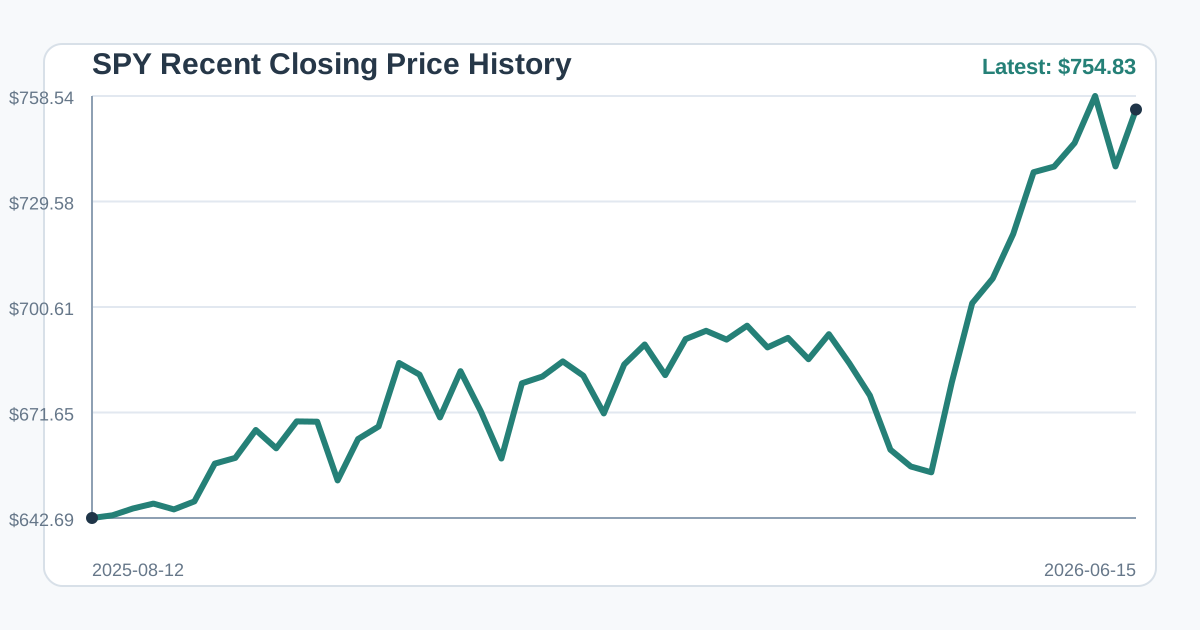
SPY, the SPDR S&P 500 ETF Trust, had a latest database close of $754.83 on 2026-06-15. In the supplied observations, SPY rose 1.76% over one session, 2.11% over five sessions, and 0.89% over 21 sessions. The difference between the one-session gain and the 21-session gain matters: most of the recent positive movement in this snapshot came from the latest short window rather than from a strong month-long advance.
The SPY price-history chart plots closing prices from 2025-08-12 through 2026-06-15, with the latest plotted close at $754.83. That date range helps place the latest one-session and five-session gains inside a longer trend, rather than treating one closing price as a complete market story.
For dividend investors, a broad-market benchmark such as SPY can be useful as context. It gives a reference point for whether individual income holdings are moving with the market, lagging it, or behaving defensively. The SPY ticker page also shows database fundamentals such as ETF type, yield, and payout-ratio fields, which can help frame it as a benchmark example rather than as a standalone dividend idea.
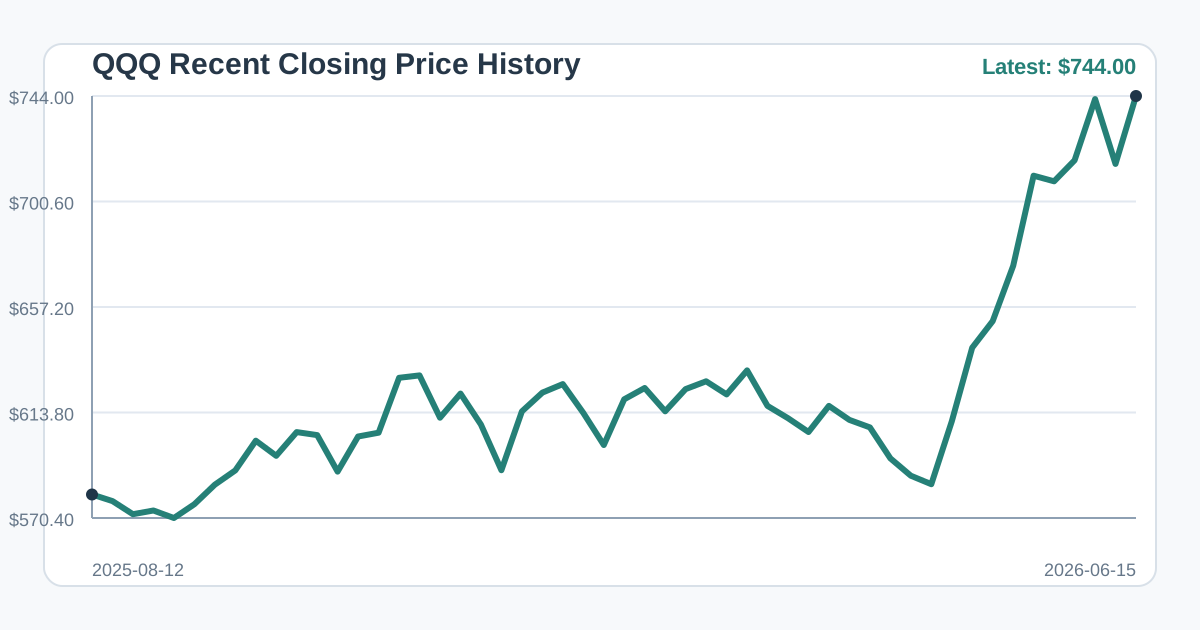
QQQ, the Invesco QQQ Trust, had a latest database close of $744.00 on 2026-06-15. In the supplied observations, QQQ rose 3.14% over one session, 3.90% over five sessions, and 3.36% over 21 sessions. Compared with SPY, QQQ showed stronger gains across all three supplied windows. That points to growth-oriented and technology-heavy leadership in this particular database snapshot.
The QQQ price-history chart plots closing prices from 2025-08-12 through 2026-06-15, with the latest plotted close at $744.00. It is useful because the one-session gain of 3.14% can be compared with the full chart range, helping readers see whether recent leadership is a short burst or part of a broader pattern in the supplied history.
The spread between SPY and QQQ is one of the clearest leadership signals in the supplied benchmark data. SPY was positive, but QQQ was more positive. That does not predict future returns, but it does describe the latest observed leadership mix: risk appetite appeared more favorable toward growth and large technology exposure than toward the broader large-cap basket.
Cross-Asset Risk Appetite
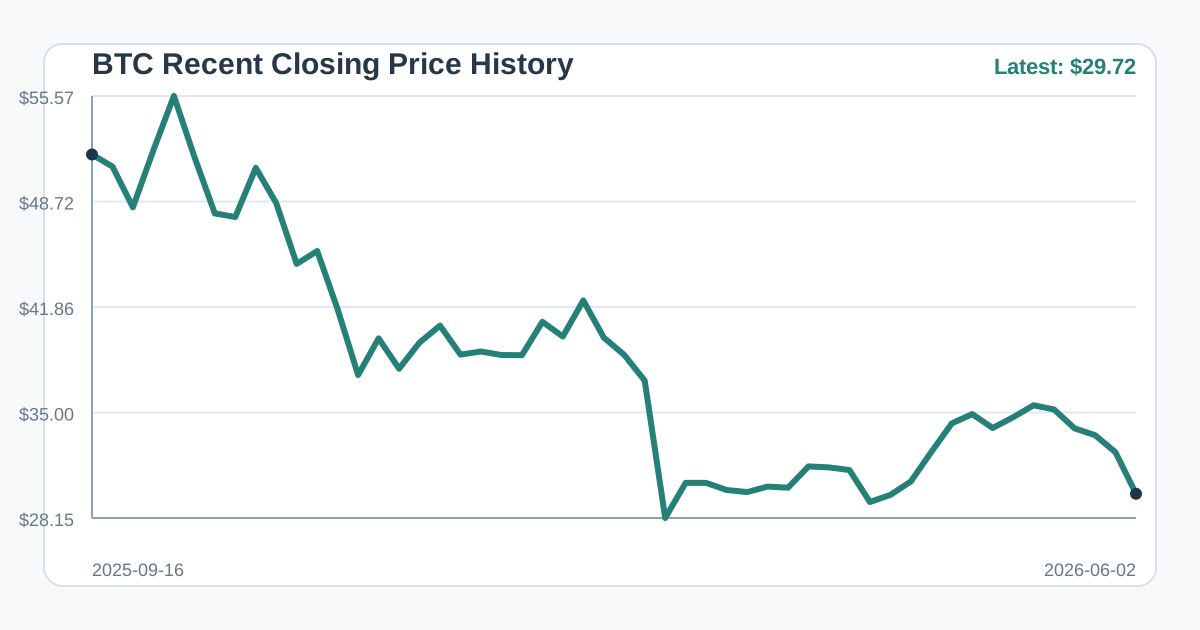
The supplied Bitcoin proxy is BTC, the Grayscale Bitcoin Mini Trust ETF. Its latest database close was $29.72 on 2026-06-02, which is older than the 2026-06-15 observations for SPY, QQQ, and gold. That date difference is important. BTC should not be compared as if it had a 2026-06-15 close in this dataset.
As of the 2026-06-02 database close, BTC was down 5.98% over one session, down 8.33% over five sessions, and down 16.84% over 21 sessions. Within the supplied data, that was a meaningful contrast to the positive U.S. equity benchmark moves observed through 2026-06-15. The cleanest interpretation is not that all risk assets were moving together, but that equity benchmarks and this Bitcoin proxy were showing different behavior over their respective latest available windows.
The BTC price-history chart plots closing prices from 2025-09-16 through 2026-06-02, with the latest plotted close at $29.72. Because the latest BTC observation is dated 2026-06-02, the chart is best used to understand the Bitcoin proxy’s prior weakness in the database rather than to describe market action on 2026-06-15.
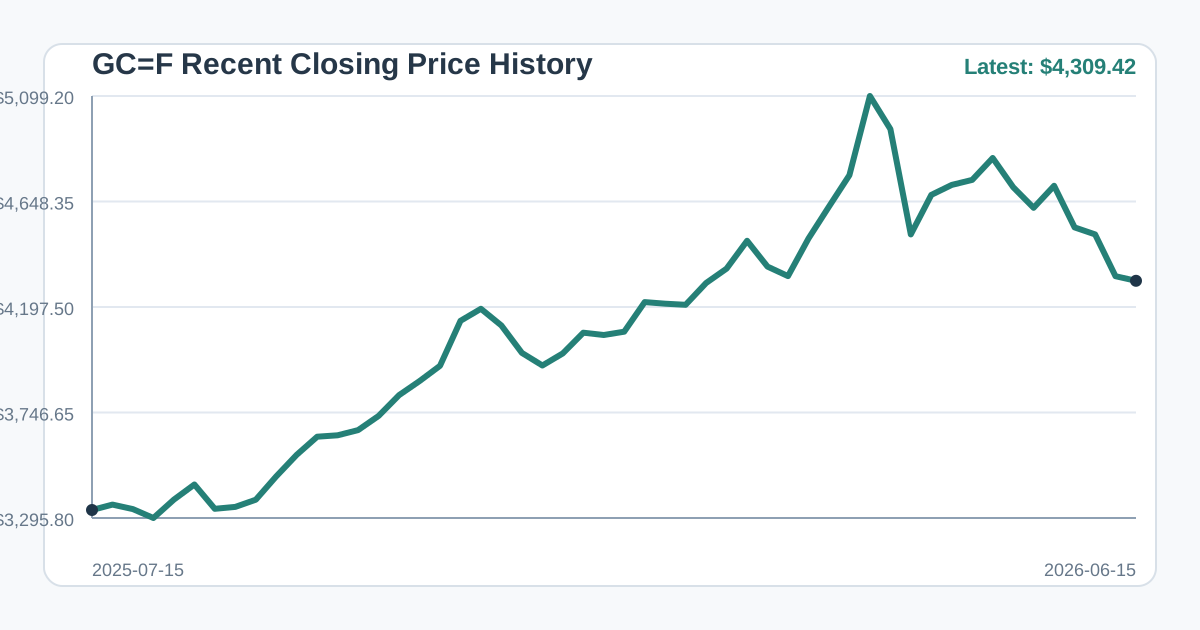
Gold, represented by GC=F, had a latest database close of $4,309.42 on 2026-06-15. It rose 2.23% over one session, slipped 0.45% over five sessions, and declined 8.63% over 21 sessions. This mix is more nuanced than a simple defensive-risk-on label. Gold was strong in the latest one-session observation, roughly flat to lower over five sessions, and clearly weaker over 21 sessions.
The GC=F price-history chart plots closing prices from 2025-07-15 through 2026-06-15, with the latest plotted close at $4,309.42. This helps separate the latest 2.23% one-session gain from the weaker 21-session context, which is important when comparing gold with equity benchmarks.
Taken together, the supplied cross-asset observations show a market snapshot with strong equity leadership, especially in QQQ, alongside a one-session rebound in gold and older negative observations for the Bitcoin proxy. That combination can occur when investors are selective rather than uniformly risk-seeking or uniformly defensive.
Leadership And Dividend Research Context
For income-focused investors, market leadership is useful context but not a substitute for dividend research. A strong QQQ move can indicate growth leadership, but QQQ’s database yield is lower than many income-focused securities. SPY and QQQ can still be useful benchmark pages because they help compare a portfolio’s price movement against broad equity and growth-heavy exposure.
Dividend research usually needs a separate lens. A reader comparing income candidates might use the stock screener to filter by yield, payout ratio, sector, valuation, and security type. For ETF-focused examples, the ETF dividend yield screen can help identify funds in a moderate yield range. Those tools do not turn a benchmark move into a recommendation, but they can make the research process more structured.
Payout quality also matters. A high yield can reflect income strength, valuation pressure, or both. The dividend safety payout-ratio screen is one way to study examples where yield and payout-ratio filters are bounded. That type of screen is especially relevant when broad markets are rising, because rising prices can compress yields and make headline income levels look less attractive than they did at lower prices.
Largest One-Session Moves As Research Leads
The largest latest one-session moves in the supplied historical_prices observations were extreme. SYRS rose 300.00% from 2026-06-12 to 2026-06-15, but the supplied prices are shown as $0.00 to $0.00. SNAX fell 99.70% from $0.03 to $0.00 over the same dates. SCPX fell 90.09% from 2026-06-11 to 2026-06-15, also moving from $0.01 to $0.00 in the rounded display.
Those examples are important because percentage changes can become misleading when the price base is tiny or rounded to two decimals. A move from fractions of a cent, a corporate action, a stale quote, a delisting process, or a data vendor adjustment can produce dramatic percentage changes without offering a straightforward investment signal. These observations should be treated as prompts for further research, including checks for splits, symbol changes, bankruptcies, exchange notices, and data anomalies.
Other large moves in the supplied list include SRNE, up 66.67% from 2026-06-12 to 2026-06-15, HSPTR, up 64.14% from 2026-06-11 to 2026-06-12, and VRPX, up 60.00% from 2026-06-12 to 2026-06-15. The list also includes several warrants and rights, such as BNCWW, AIIOW, WTGUR, and NUAIW. Warrants and rights can trade differently from common shares, often with lower liquidity and greater sensitivity to deal terms or corporate events.
For an income investor, the key lesson is process discipline. A large one-session move may be worth investigating, but it should not automatically be interpreted as improved dividend quality, better fundamentals, or durable demand. Before using any such move in a portfolio review, it is reasonable to verify the instrument type, liquidity, corporate-action history, and whether the displayed price series is reliable.
How To Use This Snapshot
This 2026-06-15 market snapshot shows QQQ leading SPY in the supplied one-session, five-session, and 21-session observations. It also shows gold rising on the latest observed day while remaining down over 21 sessions, and it shows the Bitcoin proxy with an older 2026-06-02 close and negative changes across the supplied windows. That is a mixed cross-asset picture, not a forecast.
A practical research workflow is to separate benchmark context from portfolio decisions. Benchmark pages such as SPY and QQQ can help frame leadership. Screens can help narrow dividend candidates. Tools such as the stock forecast planner and DRIP calculator can help compare scenarios without assuming that recent benchmark moves will continue.
The main takeaway is measured interpretation. The supplied observations point to growth-led equity strength through 2026-06-15, selective cross-asset behavior, and several extreme single-name moves that need verification before drawing conclusions. For dividend research, those facts are useful background, but income durability still depends on cash flows, payout policy, balance-sheet quality, and valuation discipline.